

Ask five people about the Dubai property market right now and you will get five forecasts, most of them borrowed from a headline. The registered transaction data tells a more grounded story, and a better one: a market that has grown 8% in a year, is holding near the highest prices ever recorded in the series, and is settling from a record-breaking sprint into a steadier walk.
That settling is the part headlines dramatise and buyers misread. So this forecast does something more useful than predicting December: it shows exactly where every line stands after two remarkable years, what a maturing phase looks like in the numbers, and the five indicators that will confirm the next leg before any headline does.
Where prices actually are
Across the twelve months to late July 2026, Dubai residential property sold at a median of AED 1,738 per square foot, 8.0% above the AED 1,609 of the twelve months before. Half-year against half-year tells the same story: H1 2026 at AED 1,738 against H1 2025's AED 1,636, up 6.2%. By either cut, the market is meaningfully more valuable than it was a year ago.
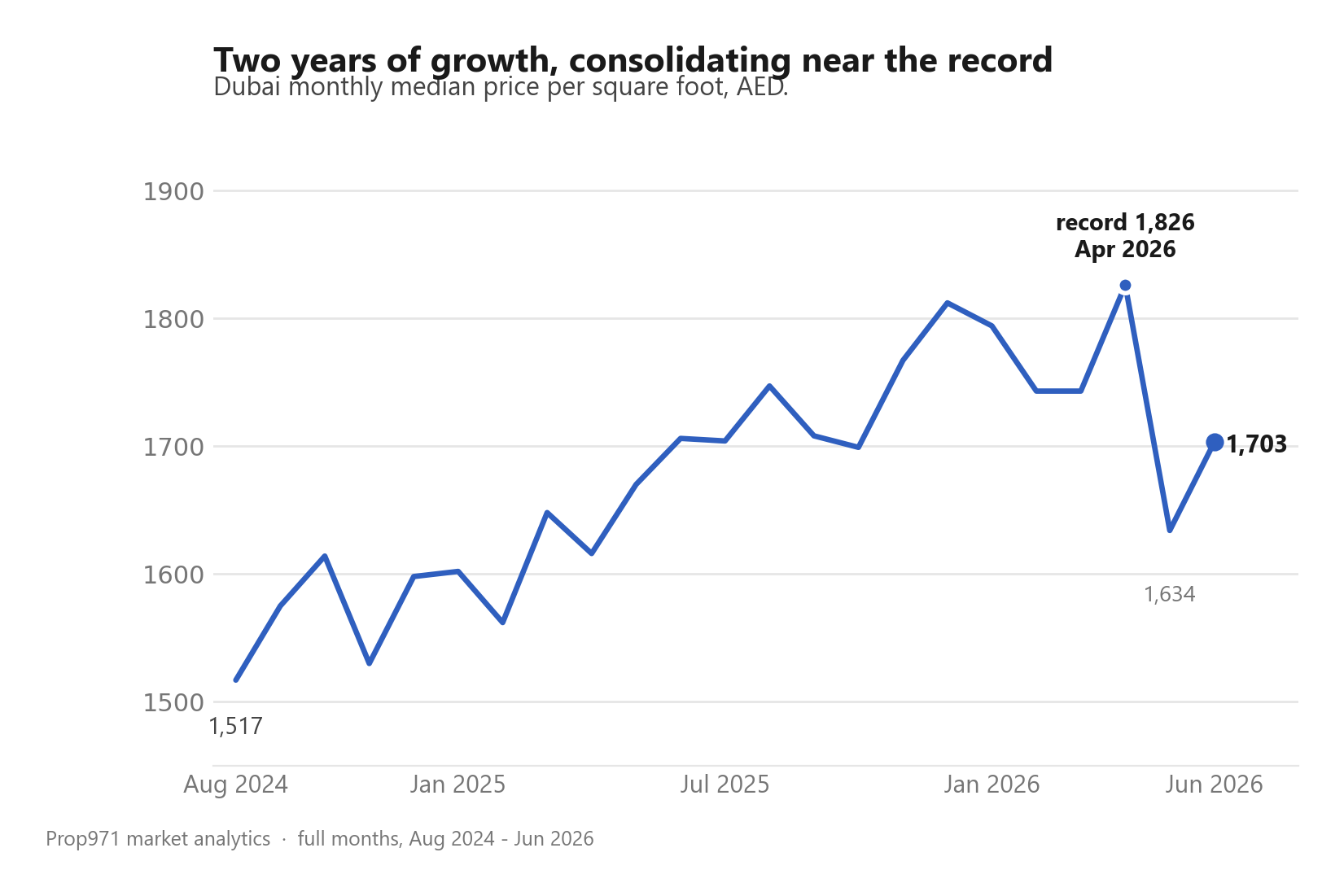
The monthly median set its record at AED 1,826 in April 2026, the highest point in the two-year series, and stood at AED 1,703 in June, within 7% of that record and 3.1% above the same months last year. After two years of near-continuous climbing, prices are consolidating just under their peak rather than pushing higher every single month, which is what maturing markets do after a strong run.
One reading note that keeps the chart honest: the sales mix is shifting toward new launches. Off-plan units took 69% of H1 2025 sales and 76% of H1 2026's, reaching roughly 8 in every 10 sales by the June quarter. New launches price differently from older stock, so monthly wiggles partly reflect what sold, not what your home is worth. May's brief dip to AED 1,634 came on the quietest sales month in the series and read as noise; June promptly recovered to 1,703.
A calmer sales pace after a record 2025
2025 was the busiest year in the series: monthly transactions peaked at 17.8k in September 2025, and the autumn quarters each cleared 50k sales. Against that record base, 2026 has found a calmer rhythm: 11.1k sales in June, with the June quarter at 30.7k, 27% below the same quarter of the record year.
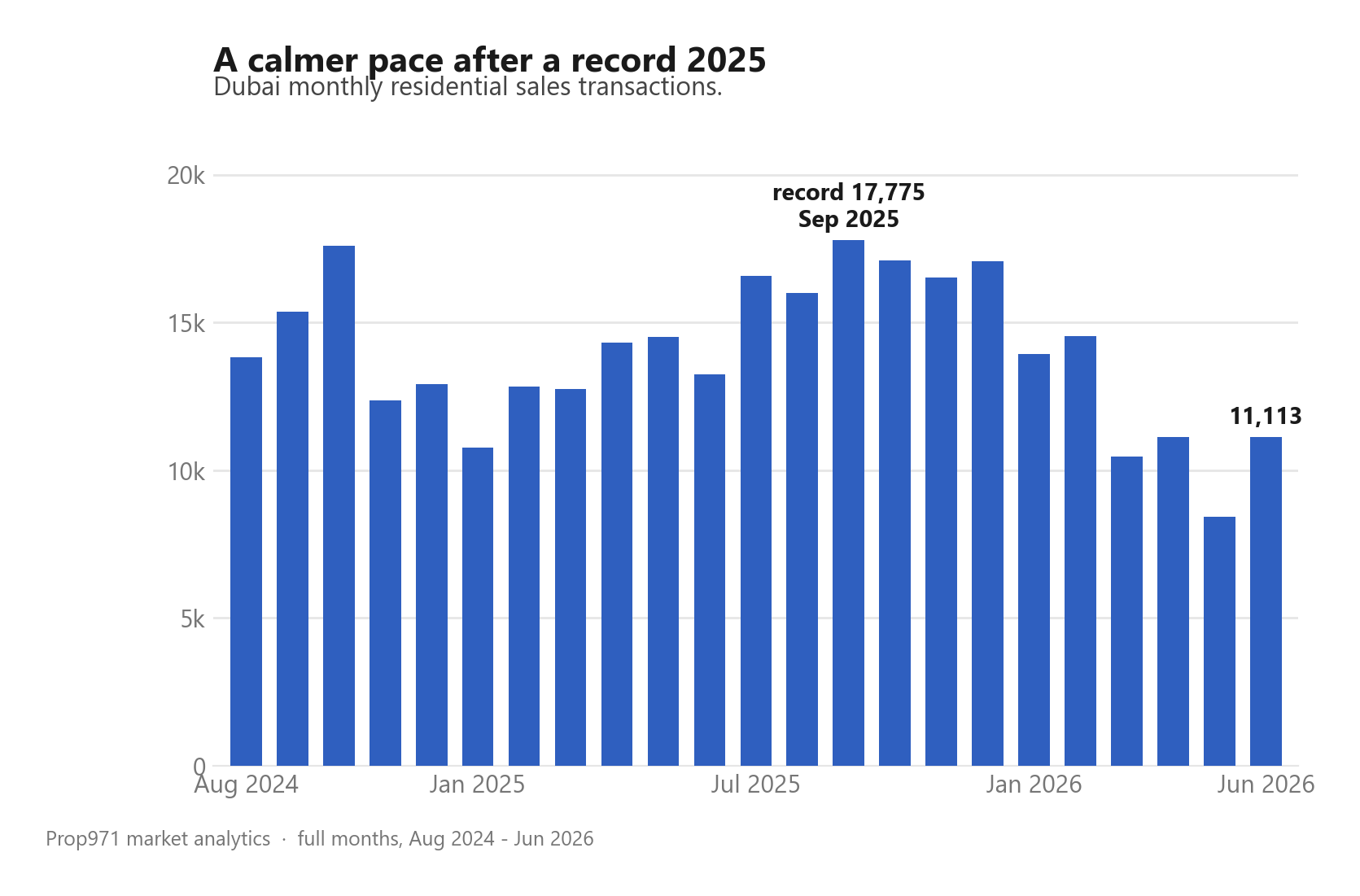
Two details inside that number are quietly reassuring, and both get less attention than they deserve.
First, the slowdown is concentrated in resales, which fell from 30% of H1 2025 sales to 23% of H1 2026's. Owners are holding, not queueing to exit; a market losing confidence shows the opposite pattern, resale listings surging as people rush out. Second, the primary market has kept selling: developers still found buyers for roughly three-quarters of everything transacting, which is a continuing vote of confidence in the market's pipeline at full prices.
A calmer sales count also matters mechanically for reading prices: volume moves before price in any property market, so the series to watch for the next acceleration is transactions, not the median. The 2025 record showed how quickly Dubai's demand can fill a quarter; the question for late 2026 is when, not whether, the pace picks back up toward it.
Is the Dubai property market going to crash?
The registered data shows no sign of one: prices sit within 7% of their April 2026 record and 3.1% above the same period last year, owners are holding rather than exiting, and developers keep selling at full prices. Every measurable warning light a genuine crash would trip, prices deep below year-ago levels, resale share surging, launch demand evaporating, currently reads healthy.
The claim circulating online that Dubai is "down 40% from peak" is a mix-up worth settling: it loosely matches the sales COUNT against its single record month, and matches no price series in the registered data at all. Comparing an ordinary month to the best month ever recorded and calling the difference a fall is like calling a shop quiet because it sells less than it did on its best-ever Saturday.
No two-year dataset guarantees the future, and this one does not try to. What it supports saying is that mid-2026 Dubai looks like a market digesting an exceptional run from a position of strength: record prices roughly held, sellers unpressured, new supply still being absorbed.
The Dubai property market outlook for the rest of 2026
Published outlooks for 2026 cluster around continued moderate growth, and the data gives that view real support: prices above year-ago levels, yields improving, and a developer pipeline still selling through. Rather than adding another percentage to the pile, here are the three confirmations worth watching into the autumn, each checkable monthly:
- Volumes turning back up. The June quarter's 30.7k is the base; movement back toward the record year's 50k quarters would confirm demand re-accelerating.
- Prices holding their ground. The June median sits 3.1% above last year. Holding or extending that gap keeps the consolidation story intact and sets up the next advance from a higher floor.
- The launch share easing back. Off-plan at 8 in 10 sales shows developer strength; a drift back toward 7 in 10 would signal the resale market re-engaging alongside it, the broadest version of health.
What rents say about the Dubai property rental market
Rents are the market's built-in support, and right now they are working in buyers' favour. Gross yields on finished Dubai stock run about 7.0% for studios, 5.4% for one-beds, 3.8% for two-beds and 3.7% for three-beds, computed against what finished property actually sells for.
The mechanism is simple and strong: whenever sale prices pause while rents hold, yields rise, and rising yields recruit income buyers who need no price growth at all to be happy. That demand engages hardest in the affordable districts already yielding 7 to 8%, and it is one of the structural reasons Dubai's consolidations have tended to be shallow: the rental market keeps paying owners to wait.
The five numbers that will tell you first
Every argument above reduces to five series, and all five are public:
1. Monthly median price per square foot, the headline (record AED 1,826 in April, AED 1,703 in June)
2. Monthly transaction count, the early signal (17.8k record, 11.1k now, the one to watch for re-acceleration)
3. Off-plan share of sales, the pipeline's strength (roughly 8 in 10)
4. Resale share, the confidence tell (23% and steady-to-falling means owners are holding)
5. Gross yield by bedroom count, the support (7.0% studios down to 3.7% three-beds)
Dubai's official benchmark for the first is the Residential Property Price Index published by the Dubai Land Department, with the underlying open records available through the government's open data portal. Both are authoritative, and both publish on official timetables, which means a quarterly index confirms a turn a quarter after it happened.
The five series above move daily, and re-checking them each month is exactly the dull, repetitive work almost nobody actually does. Our market analytics track all five from the same transaction data this article is computed from, refreshed daily, cut by district, bedroom count and off-plan status, so the check takes minutes. District level is where the citywide story splits anyway: the best-areas analysis found districts from +26% growth to 8%-plus yields inside the same market, and sellers weighing their timing have their own numbers in the selling guide.
FAQ
Is the Dubai property market going to crash in 2026?
No sign of it in the registered data: prices are within 7% of their April 2026 record and 3.1% above the same period last year, owners are holding rather than exiting, and developers keep selling at full prices. The measurable warning signs a crash would show, prices deep below year-ago levels and resale listings surging, are absent through June 2026.
Are Dubai property prices still rising?
On the year, clearly: the twelve-month median is up 8.0%, and H1 2026 came in 6.2% above H1 2025. Month to month, prices are consolidating just under April's record AED 1,826 per square foot, which is the normal breathing pattern after a two-year climb.
Why are sales volumes lower than last year?
Because 2025 set the record: the June 2026 quarter's 30.7k sales compare against the busiest stretch in the series, when quarters cleared 50k. The calmer pace is concentrated in resales, meaning owners are holding, while developer launches keep selling, which is the healthier version of a slowdown.
What is the Dubai property market forecast for the rest of 2026?
The data supports the moderate-growth consensus: prices above year-ago levels, yields improving, and launch demand intact. The confirmations to watch monthly are volumes turning back toward the record year's pace, the median holding its 3.1% year-on-year edge, and the resale market re-engaging.
What is the Dubai property price index?
The Residential Property Price Index (RPPI) is the Dubai Land Department's official measure of residential price movement, published on the DLD site. Transaction-level data shows the same movement daily and by district, ahead of the quarterly index print.
Is 2026 a good time to buy property in Dubai?
The conditions favour an unhurried buyer: more choice than the record year offered, sellers negotiating rather than auctioning, prices holding near records with an 8% annual gain behind them, and yields at 7%-plus in the affordable districts. Buying into consolidation has historically beaten buying into a sprint, and the five indicators above tell you when the sprint resumes.
References
Figures in this article are computed from official UAE property transaction records (DLD) via Prop971 market analytics, including transactions up to 27 July 2026.


