
A one-bedroom apartment in Dubai can be 636 square feet or 1,103 square feet, and both are advertised as a one-bedroom.
That is the same word doing very different work. Across 64,221 one-bedroom apartment sales in Dubai over the last twelve months, the middle 80% ran from 635 to 959 square feet, and the district medians stretched wider still. The bedroom count tells you how many doors there are. It does not tell you how much home you are buying, and it is the number almost every search filter is built around.
So here is what each label actually measures, and what it costs.
What a studio, a one-bed and a two-bed actually measure
| Apartment | Median size | Middle 80% | Median price | Per sq ft | Sales |
|---|---|---|---|---|---|
| Studio | 402 sq ft | 345 to 490 | AED 699,000 | AED 1,762 | 44,162 |
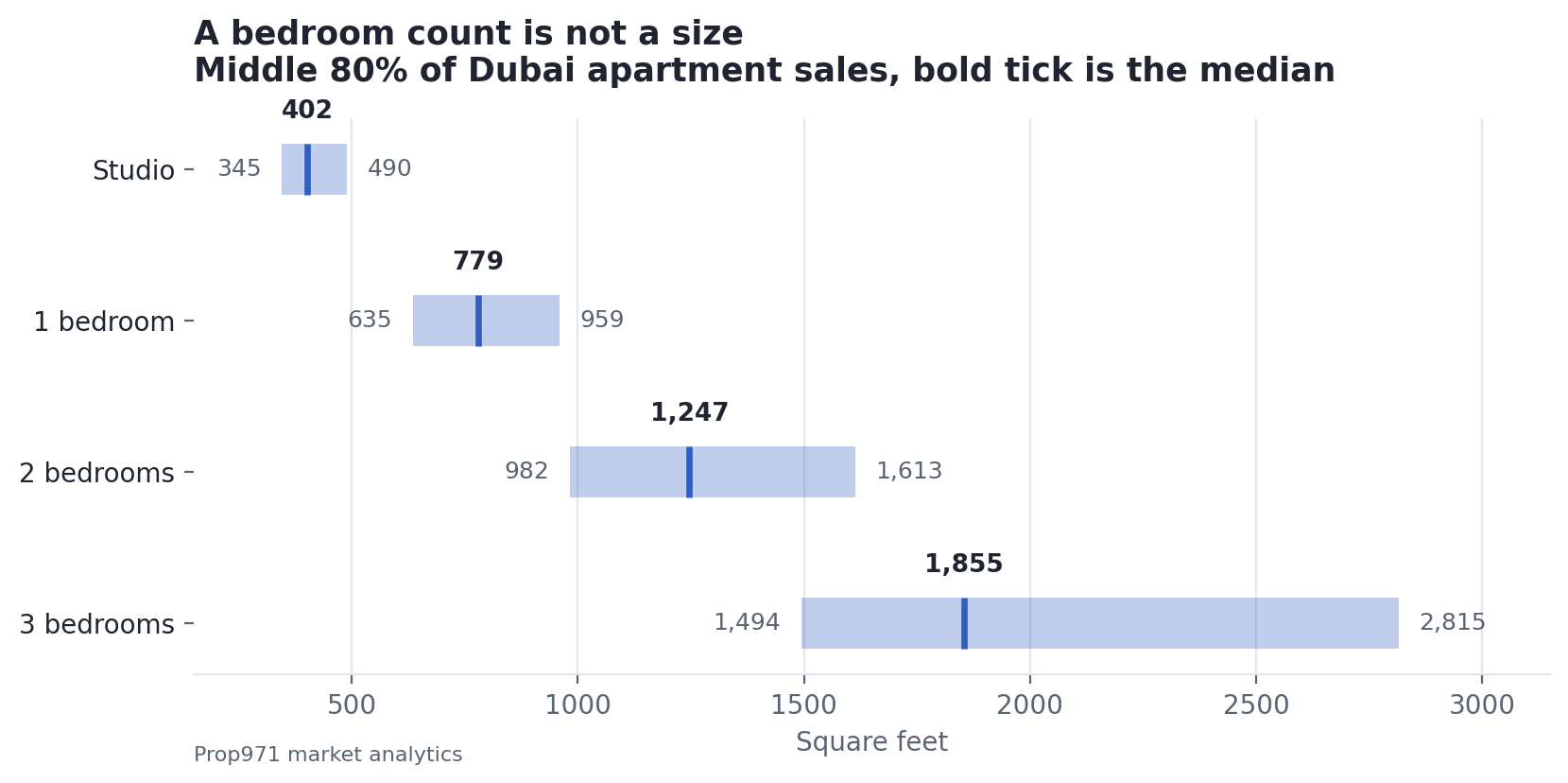
| 1 bedroom | 779 sq ft | 635 to 959 | AED 1,262,000 | AED 1,638 | 64,221 |
| 2 bedrooms | 1,247 sq ft | 982 to 1,613 | AED 2,245,000 | AED 1,798 | 34,482 |
| 3 bedrooms | 1,855 sq ft | 1,494 to 2,815 | AED 4,005,000 | AED 2,154 | 8,055 |
Dubai apartment sales in the twelve months to 26 August 2026. Middle 80% is the 10th to 90th percentile of size, in square feet.
Two things in that table are worth sitting with.
The first is the spread inside every row. A Dubai studio is typically 402 square feet, but the middle 80% of them run from 345 to 490. A two-bedroom is typically 1,247 square feet, with the same 80% band running from 982 to 1,613. The bigger the unit, the wider the band gets: studios vary by a factor of 1.4 between the tenth and ninetieth percentile, three-bedrooms by 1.9.
The second is that studios and one-bedrooms are 71% of the Dubai apartment market. This is not a niche corner of the data. It is the market.
The same bedroom count, a 2.8 times price range
Sizes vary. Prices vary more.
Take one-bedroom apartments alone. The cheapest tenth sold at or below AED 835,000. The most expensive tenth started at AED 2,333,000. Same label, same bedroom count, and a 2.8 times gap between the two ends of the market.
Some of that is size, and most of it is not. A buyer moving from a 636 square foot one-bed to a 1,103 square foot one-bed gains 73% more space. The price gap across the same range is far larger than 73%, because location is doing the heavy lifting and square footage is only riding along.
Which is why "I am looking at one-bedrooms" is not a budget, and it is not a specification either. It is a filter setting.
Where a one-bedroom gives you the most space
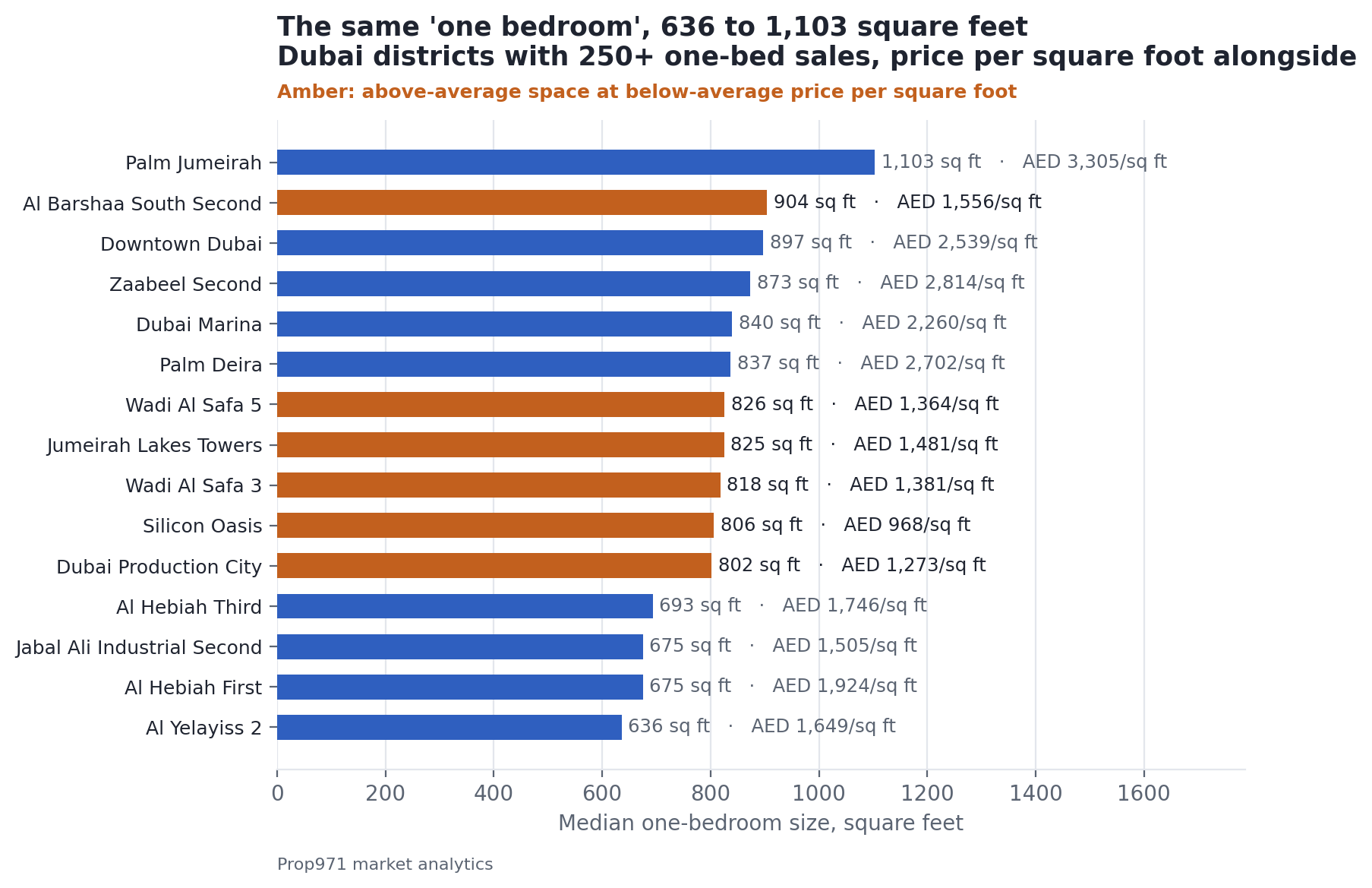
The interesting part of that chart is not the top. It is that size and price per square foot barely track each other.
Silicon Oasis one-bedrooms run about 806 square feet at roughly AED 968 per square foot. Elsewhere in the city there are districts where a one-bedroom is nearer 675 square feet and changes hands at close to AED 1,924 per square foot. That is around 16% less space at roughly double the rate per foot, in the same emirate, in the same bedroom category, in the same twelve months.
The reverse also shows up. A one-bedroom in Business Bay sits near 829 square feet at about AED 2,532 per square foot, while a one-bedroom on the outer edge of the same size band can be found at less than two thirds of that rate. Space is not the thing being priced. Address is.
The practical version: check the square footage before the bedroom count, and check the price per square foot before the sticker price. Both numbers are printed on every listing worth taking seriously, and together they answer a question the headline price cannot.
The cheapest square footage in Dubai is not the smallest apartment
There is a reasonable assumption that small units are the efficient way to buy, on the grounds that you pay for less. The per-foot numbers say otherwise.
In Dubai, over the last twelve months, apartments sold at roughly:
- Studio: AED 1,762 per square foot
- One-bedroom: AED 1,638 per square foot
- Two-bedroom: AED 1,798 per square foot
- Three-bedroom: AED 2,154 per square foot
The studio is not the cheapest square footage in the city. The one-bedroom is, by about 7% against the studio and 9% against the two-bedroom. A studio buyer is paying a premium per foot for the privilege of buying fewer of them, and a three-bedroom buyer is paying a different premium because larger apartments cluster in more expensive districts.
Efficient!
There is a second squeeze underneath this one. Newly built Dubai studios are running about 395 square feet against 441 for studios resold from the existing stock, roughly 10% smaller. For one-bedrooms the same comparison is 775 against 793, close enough to call flat. Whatever is happening to unit sizes is happening at the bottom of the range, where the buyer is least able to absorb it.
Abu Dhabi builds bigger, at every bedroom count
The other emirate is a genuine contrast rather than a rounding difference.
Abu Dhabi apartments are larger than Dubai apartments at every bedroom count in the data: studios 485 square feet against 402, one-bedrooms 880 against 779, two-bedrooms 1,417 against 1,247, three-bedrooms 2,051 against 1,855. An Abu Dhabi studio is about 21% bigger than a Dubai studio, and an Abu Dhabi one-bedroom is roughly the size of a generous Dubai one-bedroom.
The rate per foot is not lower for it. Abu Dhabi one-bedrooms traded around AED 1,887 per square foot against AED 1,638 in Dubai. So the Abu Dhabi buyer gets more space and pays more per foot of it, which nets out to a higher median one-bedroom price, near AED 1.67M against AED 1.26M. Different product, not a discount. Ownership rules also differ by emirate and by zone, which the UAE government portal sets out before you start comparing floor areas across the two. Off-plan projects in Abu Dhabi are worth reading against these size figures rather than against Dubai prices.
How to use this when you are actually shopping
Four checks, each of which takes under a minute.
Convert every listing to square feet per dirham before comparing anything. Two one-bedrooms at AED 1.2M are not the same purchase if one is 700 square feet and the other is 900. That is a 29% difference in what you own, hiding behind an identical headline.
Compare against the district median, not the city median. A 780 square foot one-bedroom is average for Dubai and small for Downtown Dubai, where the median runs closer to 897. The city number is a starting point and the district number is the real benchmark. Our area pages carry the district figures next to the current stock.
Check the balcony treatment. The area recorded against a title deed follows a defined measurement standard, and the one in a brochure does not have to. A "900 square foot" apartment that counts a large terrace is a different home from one that does not, so ask which number you are being quoted, and check it against the registered area on the title documents through the Dubai Land Department before you sign anything.
Then check the payment terms against the size, not the price. A larger unit on a slower plan and a smaller unit on a faster one can cost the same per month and leave you owning very different amounts of Dubai. Current developer terms sit on our offers page, and the ROI tools will run the yield on whichever size you land on.
None of this requires a view on where the market is going. It only requires knowing that the label on the listing is a door count, and the thing you are buying is measured in feet.
FAQ
How big is a one-bedroom apartment in Dubai?
The median one-bedroom apartment in Dubai measured 779 square feet across sales in the twelve months to August 2026. The middle 80% ran from 635 to 959 square feet, and district medians stretched from about 636 to 1,103, so the label alone is a weak guide to size.
How big is a studio in Dubai?
The median Dubai studio was 402 square feet, with the middle 80% between 345 and 490. Newly built studios are running about 395 square feet against 441 for studios resold from existing stock, roughly 10% smaller.
What is the average size of a two-bedroom apartment in Dubai?
The median two-bedroom was 1,247 square feet, with the middle 80% from 982 to 1,613. Two-bedrooms show a wider size spread than one-bedrooms, and three-bedrooms wider still, so the bigger the unit the less the bedroom count tells you.
Are apartments bigger in Abu Dhabi or Dubai?
Abu Dhabi, at every bedroom count in the data. Studios ran 485 square feet against 402 in Dubai, one-bedrooms 880 against 779, two-bedrooms 1,417 against 1,247 and three-bedrooms 2,051 against 1,855. Abu Dhabi one-bedrooms also traded at a higher rate per square foot, near AED 1,887 against AED 1,638.
Which bedroom count is cheapest per square foot in Dubai?
The one-bedroom, at roughly AED 1,638 per square foot, against AED 1,762 for studios, AED 1,798 for two-bedrooms and AED 2,154 for three-bedrooms. Smaller does not mean cheaper per foot, because studios carry a premium rate and larger apartments sit in more expensive districts.
Why do two apartments with the same bedroom count cost so differently?
Location does most of the work. One-bedroom prices in Dubai ran from about AED 835,000 at the tenth percentile to AED 2,333,000 at the ninetieth, a 2.8 times gap, while the size range across the same set was far narrower. Comparing price per square foot against the district median is the quickest way to see which side of that gap a listing sits on.
References
Figures in this article are computed from official UAE property transaction records (DLD, ADREC) via Prop971 market analytics, including transactions up to 26 August 2026.


