

There is a right time of year to buy property in Dubai, and it is not the one you have been sold.
The advice usually runs the other way. Buy in the summer, when everyone is away and sellers are desperate. Wait for the quiet months and name your price. Two years of Dubai sales say that theory is worth roughly nothing. The month you buy in moves the price by low single digits, in a direction that flips depending on which half of the market you are in. What it moves a great deal is how many homes you get to choose between.
Dubai buys homes in the autumn
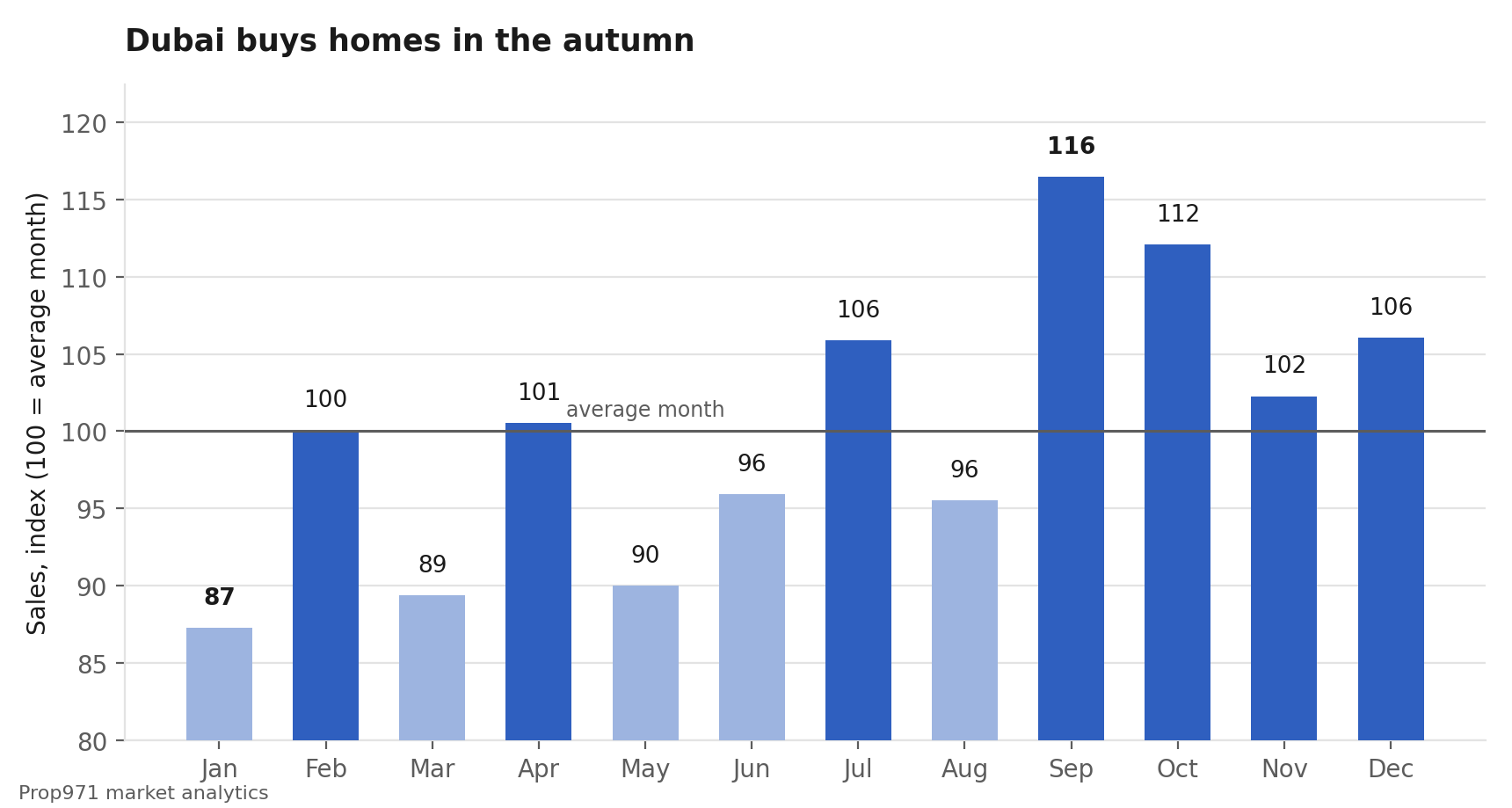
Volume is where the calendar shows up, and it is not subtle. September and October run at 116 and 112 against an average month of 100. January sits at 87, March at 89, May at 90. Between the busiest month and the quietest there are about a third more sales.
October is the figure to trust most. It is the only autumn month with two full years in this window, and both came in almost identical at 17,594 and 17,104 sales. Abu Dhabi does the same thing harder: its October index is 130, the highest month in either emirate.
The pattern is not mysterious. Residents leave for the summer, the school year restarts in September, and the property cycle restarts with it.
The price does not follow the crowd
Here is where the folk advice falls over. If a quiet market meant a cheap market, the price index would be the mirror image of the volume chart. It is not the mirror image of anything.
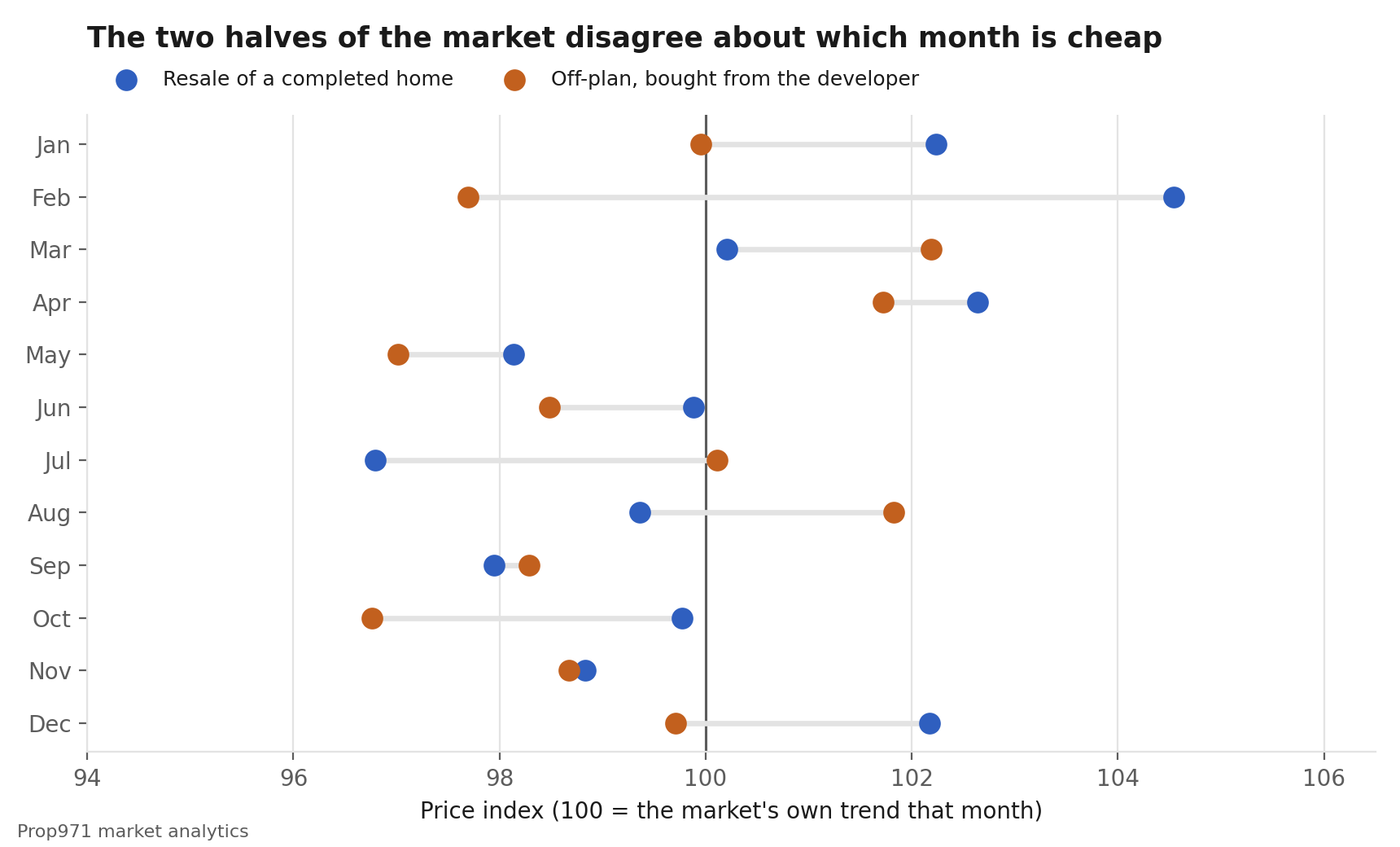
For resale, meaning a completed home changing hands, the cheapest month is July at 96.8 and the dearest February at 104.5. A spread of under eight points, which sounds like something.
Then run the same test on off-plan purchases from developers. The cheapest month is October at 96.8 and the dearest March at 102.2. July, the bargain month in resale, is a dead-average 100.1 in off-plan. February, the most expensive month in resale, is the second cheapest in off-plan at 97.7. Same city, same weeks, opposite verdict.
Rank the twelve months by cheapness in each series and the correlation between the two rankings is +0.15, which is a statistician's way of saying the lists were shuffled independently. A real season would show up in both.
Your district has its own calendar, and it is also noise
Aggregates hide things, so the fair test is one unit type in one place. Two-bedroom resale apartments, in the districts with enough sales to say anything.
| District | Cheapest month | Dearest month | Best-to-worst gap | Sales compared |
|---|---|---|---|---|
| Dubai Marina | March | June | 14% | 2,102 |
| Downtown Dubai | May | September | 21% | 1,526 |
| Business Bay | April | November | 24% | 1,297 |
| Jumeirah Village Circle | November | September | 12% | 1,121 |
| Dubai Creek Harbour | April | March | 12% | 783 |
| Palm Jumeirah | October | August | 15% | 630 |
| Jumeirah Park area | April | January | 12% | 615 |
Two-bedroom resale apartments, October 2024 to August 2026. The gap is between the district’s own cheapest and dearest month, on median price per square foot.
Seven districts, and the cheapest month is April in three of them, March, May, October and November in the others. Within a single district the gap between its best and worst month runs from 12% to 24%, far wider than the citywide seasonal signal, which is what you would expect from small samples of individual homes rather than from a season.
Business Bay is the useful example. Its cheapest month is April and its dearest November, and if you believe that, you should also believe that in Dubai Marina the cheap month is March and the dear month is June. These are not seasons. They are two dozen apartments that happened to sell with better or worse views.
The trend costs more than the season saves
The strongest argument against waiting for a cheap month is what happens while you wait.
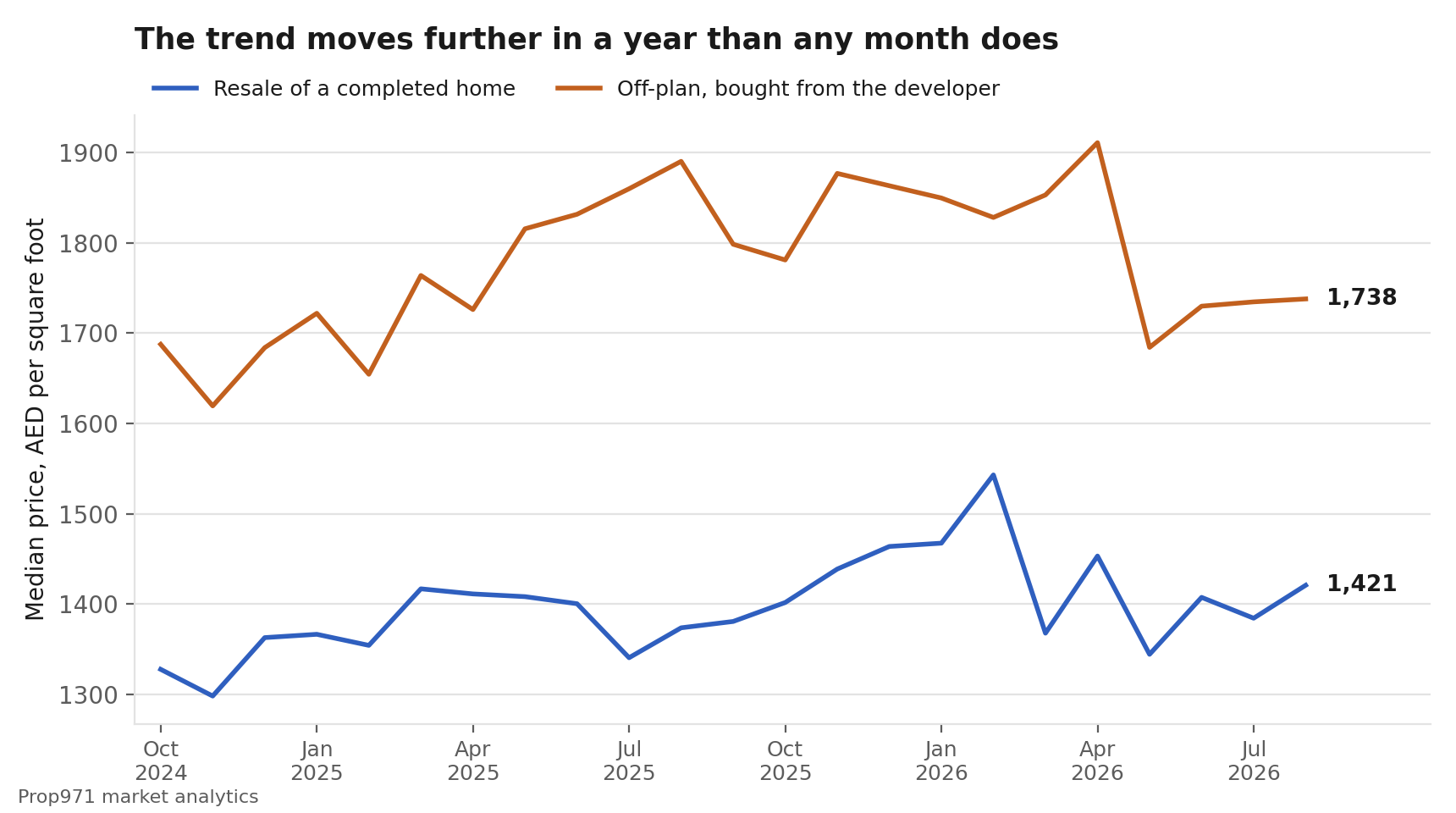
Resale prices went from AED 1,328 per square foot in October 2024 to AED 1,421 in August 2026. That is 7% over twenty-two months, about 3.8% a year, and it grinds on regardless of which month you are in.
So the arithmetic on patience is short. Waiting six months for a better month costs roughly 1.9% in trend. The best seasonal discount on offer, if it were real and if you could pick the right month in advance, is about 3%. All of that timing, for less than the market moves while you think about it.
None of that is a forecast. Prices can fall, and a 3.8% annual drift is an average across a period, not a promise about the next one. The point is narrower: whatever the trend does, it is bigger than the month.
What the calendar actually changes
The season is real. It is just measuring something other than price.
In September and October there are about a third more homes trading than in January. More listings, more handovers, more launches, more of the market visible at once. That is worth something specific: choice. If you want to compare six two-bedroom apartments in the same building before deciding, autumn is when six exist.
The quiet months invert the same fact. In January and March there is less to look at, but the seller of the thing you like is also facing fewer buyers than they were in October. Fewer people in the room is a negotiating position, and it is the honest version of the summer-discount theory: not a lower asking price, a weaker counterparty.
Which is worth more depends on what you are short of. Buying a specific unit type in a specific tower means you need inventory, so buy when inventory exists. Being flexible on layout and floor means the thin months are yours.
How to time a purchase in Dubai, in five steps
1. Set the price with comparable sales, not the month. Same district, same bedroom count, last ninety days. Our market analytics does this on transacted prices rather than asking prices.
2. Check how deep the market is before you rely on any average. A district with thirty sales a quarter produces month-to-month swings of 20% that mean nothing at all.
3. Buy in the autumn if you need selection. More stock is on the market between September and December than at any other point in the year.
4. Buy in the quiet months if you need leverage. January through May is when a seller has the fewest other buyers to play against you.
5. Do not wait more than a quarter for a better month. The trend eats the discount, and the discount was never reliable.
Residency and ownership rules do not move with the season either, and the UAE government portal is the place to check those rather than a sales office.
Developer incentives are a separate calendar, and usually a bigger number than anything here. A waiver of the registration fee charged by the Dubai Land Department is 4% of the price, more than any month in this data was worth, and those come and go on the developer's schedule rather than the season's. Our current offers page tracks the live ones, and the off-plan price gap is worth reading before you decide which half of the market you are shopping in at all.
There is no cheap month in Dubai. There is a busy season and a quiet season, and they hand you different advantages. Pick the one that matches what you are short of.
FAQ
What is the best time of year to buy property in Dubai?
There is no month that is reliably cheaper. Across the last two years the gap between the cheapest and dearest month was under 8% for resale homes and under 6% for off-plan, and the two halves of the market disagreed about which months those were. The better question is what you need: September to December carries about a third more listings and sales, while January to May is thinner and gives a buyer more negotiating room.
Is Dubai property cheaper in the summer?
No. July is the cheapest month in the resale index, at about 3% below trend, but the same month is dead average for off-plan purchases, and summer months are not cheap in Abu Dhabi at all. Summer is quieter rather than cheaper, and less stock on the market is a cost as well as an opportunity.
When is the Dubai property market busiest?
September and October, by a clear margin. Both run more than 10% above an average month, and October is the only autumn month with two complete years in this data, which came in almost identical at 17,594 and 17,104 sales. Abu Dhabi peaks in the same window, with an October index of 130 against an average month of 100.
Should I wait for prices to fall before buying in Dubai?
Waiting has a running cost. Dubai resale prices rose about 3.8% a year over the last two years, so six months of waiting costs roughly 1.9% at that pace, against a best-case seasonal saving of about 3% that you would have to predict correctly in advance. Prices can fall, and that is a different question from seasonality, but the month itself is not worth waiting for.
Does the best month to buy differ by district in Dubai?
Every district shows a different cheapest month, which is the clearest sign the pattern is noise rather than season. Among the seven deepest two-bedroom resale markets, the cheapest month was April in three, and March, May, October and November in the rest. The month-to-month swing inside one district runs from 12% to 24%, wider than the citywide seasonal signal.
References
Figures in this article are computed from official UAE property
transaction records (DLD, ADREC) via Prop971 market analytics,
including transactions up to 31 August 2026.


