
Most buying guides tell you a Dubai mortgage covers 80% of the price. That is true, and for three quarters of the properties sold in Dubai last year it is the wrong number.
A mortgage on an off-plan property is capped at 50%. Not 80, not 75. Half.
The rule sits in the Central Bank's mortgage regulations and it is unusually blunt: the maximum loan to value for property bought off plan is 50% "regardless of purpose, value, or category of purchaser." No exception for a first home, none for a UAE national, none for a modest price. Everyone, every time.
Off-plan was 76% of Dubai's sales over the last twelve months. So the number most buyers actually need is the one least often quoted at them.
What the caps actually are
The full ladder, from the Central Bank of the UAE mortgage regulations:
| Buyer and property | Property value | Maximum loan to value | Deposit needed |
|---|---|---|---|
| Any buyer, bought off plan | Any value | 50% | 50% |
| UAE national, first home, owner occupied | Up to AED 5M | 85% | 15% |
| UAE national, first home, owner occupied | Above AED 5M | 75% | 25% |
| UAE national, second or investment | Any value | 65% | 35% |
| Expatriate, first home, owner occupied | Below AED 5M | 80% | 20% |
| Expatriate, first home, owner occupied | Above AED 5M | 70% | 30% |
| Expatriate, second or investment | Any value | 60% | 40% |
Two things people misread. "First home" is once per borrower – the regulations say each borrower can only claim one property under that category, so the 80% is not a rate you keep coming back for. And the second-property caps of 60% and 65% apply regardless of value, so a modest second flat gets the same treatment as a large one.
What the 50% cap costs in cash
Rules are abstract until they are a bank transfer. Dubai's median off-plan sale over the last twelve months was AED 1.35M, and the median ready sale was AED 1.19M. Similar prices, very different deposits.
- Off-plan at the 50% cap: AED 675k down
- Ready, first home at 80%: AED 238k down
That is 2.8 times the cash for a property costing roughly the same, and it is before any fee. In Abu Dhabi, where off-plan is 80% of sales and the median off-plan price is higher, the gap widens to 4 times.
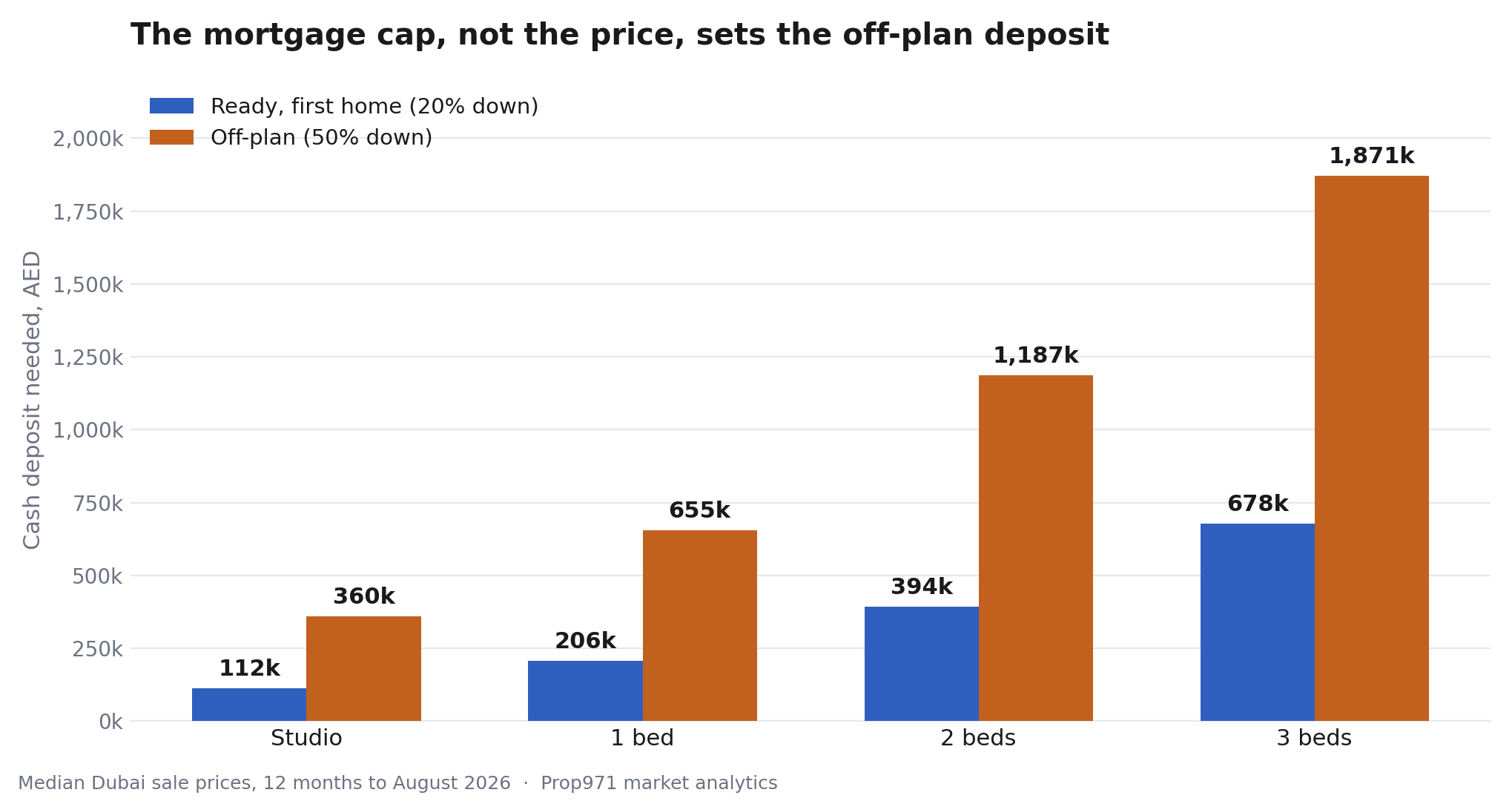
A one-bedroom is the clearest case. Ready, the typical deposit is around AED 206k. Off-plan, it is around AED 655k. The off-plan unit is more expensive to start with, but most of that gap is the cap, not the price.
So how does anyone buy off-plan?
They mostly do not use a mortgage at the point of sale. They use the developer's payment plan.
This is the part worth sitting with, because it reframes what a payment plan is. A payment plan is not a marketing sweetener. It is the financing mechanism that exists because the mortgage rules leave a hole exactly where three quarters of the market is. Construction-linked instalments spread the cost over the build, and buyers commonly arrange a mortgage at handover, when the property is complete and the ordinary 80% or 60% caps apply again rather than the off-plan 50%.
Which turns the usual question inside out. Instead of "what mortgage can I get for this off-plan unit", the useful question is "what does this payment plan require before handover, and will I qualify for a mortgage at handover on the terms available then".
The cap is also why the handover date matters more on an off-plan purchase than the brochure suggests. Until the property completes, the 50% ceiling applies and the deposit is the developer's schedule. After it completes, the ordinary caps return and the same buyer can suddenly borrow 80%. Nothing about the buyer changed. The building did.
Whether you will qualify at handover is the part nobody can promise you. Your salary, your other debts and the bank's appetite in two years are not knowable today. What you can pin down now is the schedule, and payment plans differ far more than brochures suggest – some front-load half the price before handover, some ask 20%. Those are not the same product and they are not published anywhere you can sort them, which is why our off-plan project pages put the payment plan next to the price and the handover date.
The ratios that decide the answer for you
Two more numbers from the same regulations, both of which quietly settle whether a mortgage happens at all.
Debt burden ratio, 50%. Total monthly commitments cannot exceed half of gross salary and regular income. Car finance and credit cards count. This is the constraint that catches most applicants, not the deposit.
Worth doing the arithmetic once, because it is unforgiving. On a gross salary of AED 30k a month, everything you owe monthly has to fit inside 15k. A car payment of 3k and a credit card minimum of 1k leave 11k for the mortgage instalment. The regulations also note that banks do not automatically lend to the maximum ratio, so 11k is a ceiling rather than an entitlement. Two people on identical salaries can get very different answers, and the difference is usually the debt they already carry rather than the property they chose.
Maximum term, 25 years. Repayment must come from salary or verifiable business or rental income, and the regulations specifically bar using an End of Service Benefit as the repayment source.
There is no published national interest rate to quote here. Rates are set per bank and per applicant, they move with the market, and anyone giving you one number for "the Dubai mortgage rate" is describing their own offer rather than the market.
The fee people forget
Registering the mortgage costs 0.25% of the loan value, paid to the Dubai Land Department.
On a 1M loan that is 2,500 dirhams. Small next to the 4% transfer fee, and it is a separate charge on a separate base – the transfer fee is a share of the property price, the mortgage fee a share of the borrowing. Budget them as two lines rather than one.
A test you can run before you fall in love with a unit
Three steps, in this order, because the third one is the one that stops purchases.
Work out the deposit at the right cap. Off-plan, halve the price. Ready first home, take a fifth. Second property, take 40%. If that number is not sitting in your account, the rest of the exercise is decoration.
Add the fees on top. The 4% transfer fee applies to the price, and mortgage registration adds 0.25% of the loan. Both sit outside the deposit.
Check the ratio, not the deposit. Add every monthly commitment you already have, add the projected instalment, and divide by gross monthly income. Above 50% and the deposit does not matter, because the application will not clear. This is the check people run last and should run first.
FAQ
Can you get a mortgage on off-plan property in Dubai?
Yes, but it is capped at 50% loan to value by the Central Bank of the UAE, regardless of the buyer's nationality, the property value or whether it is a first home. That is why most off-plan buyers use a developer payment plan during construction and arrange a mortgage at handover instead.
How much deposit do you need for off-plan in Dubai?
At least 50% of the price if you are financing with a mortgage, before fees. On Dubai's median off-plan sale of AED 1.35M over the last twelve months, that is roughly AED 675k, against about AED 238k for a first-home purchase of comparable ready property at the 80% cap.
What is the maximum mortgage in Dubai for expats?
For a first home occupied by the owner, 80% of the value below AED 5 million and 70% above it. For a second or investment property it is 60% regardless of value. UAE nationals get 85%, 75% and 65% on the same tiers.
How much can I borrow for a Dubai mortgage?
The lower of two limits: the loan-to-value cap for your buyer category, and whatever keeps your total monthly commitments under 50% of gross income, which is the Central Bank's debt burden ratio. The maximum term is 25 years.
Is a mortgage cheaper than a developer payment plan?
They are not directly comparable. A payment plan spreads the price over construction with no interest in the usual sense but no ownership until handover, while a mortgage carries interest and a lien. The practical difference for most buyers is timing of cash, not headline cost.
What fees come with a Dubai mortgage?
Mortgage registration is 0.25% of the loan value at the Dubai Land Department, separate from the 4% property transfer fee, which is charged on the price rather than the loan. Banks add their own arrangement and valuation charges.
References
Figures in this article are computed from official UAE property transaction records (DLD, ADREC) via Prop971 market analytics, including transactions up to 13 August 2026.


