
Abu Dhabi property repriced three times faster than Dubai last year. The median price per square foot across the emirate rose 20.6%, from about AED 1,438 to AED 1,733. Dubai, over the same twelve months, managed 6.1%.
For a decade the answer to where to invest in the UAE was Dubai by default. The transaction record no longer supports that. It also does not support taking the 20.6% at face value, and the rest of this is about which parts of it are real.
Where the growth actually landed
Districts with at least 150 registered sales in both windows, measured on the median price per square foot:
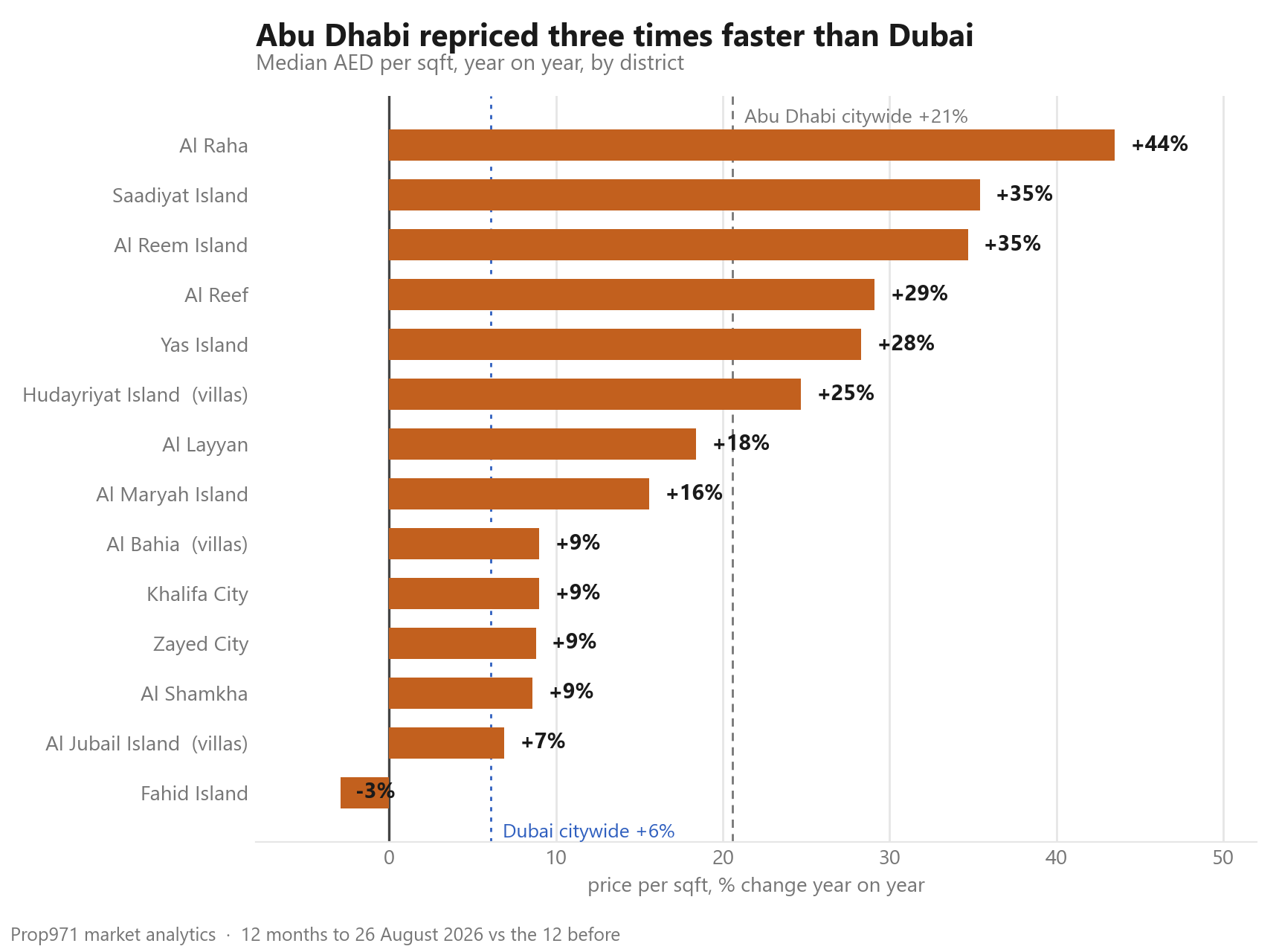
Nine of the fourteen beat Dubai's citywide figure by a factor of three or more. That is the story in one line, and it is not the whole story.
How much of that growth is real
Here is the number that should temper every figure above: 80% of everything sold in Abu Dhabi over the last year was off-plan, and off-plan trades at a 37% premium per square foot over finished stock. In Dubai the equivalent premium is 28%.
When an emirate sells four fifths of its volume unbuilt at a 37% markup and its median rises, some of that rise is simply more expensive launches entering the sample. That is not the same fact as the flat you already own being worth more.
There is a test, and it takes ten seconds. Look at the district's volume alongside its price. If sales doubled and the median jumped, the median moved because what was selling changed. If the median jumped while sales fell, somebody actually paid more for the same thing.
Run that test on the top three and they split cleanly:
- Saadiyat Island, +35% on volume that fell 22%. Fewer sales, higher prices. That is repricing, and it is the cleanest growth signal in the emirate.
- Al Raha, +44% on volume up 41%. Above the 40% line where growth stops being a finding and starts being a mix change. Treat it as unproven.
- Al Reem Island, +35% on volume up 129%. The biggest volume surge on the list. Some of that 35% is composition.
The same test buries the emirate's outlier. Fahid Island is the only district where prices fell, down 3%, on volume up 438%. A district that quadruples its sales and prices lower is a district in the middle of a launch programme, not a district losing value.
Where the rent actually pays you back
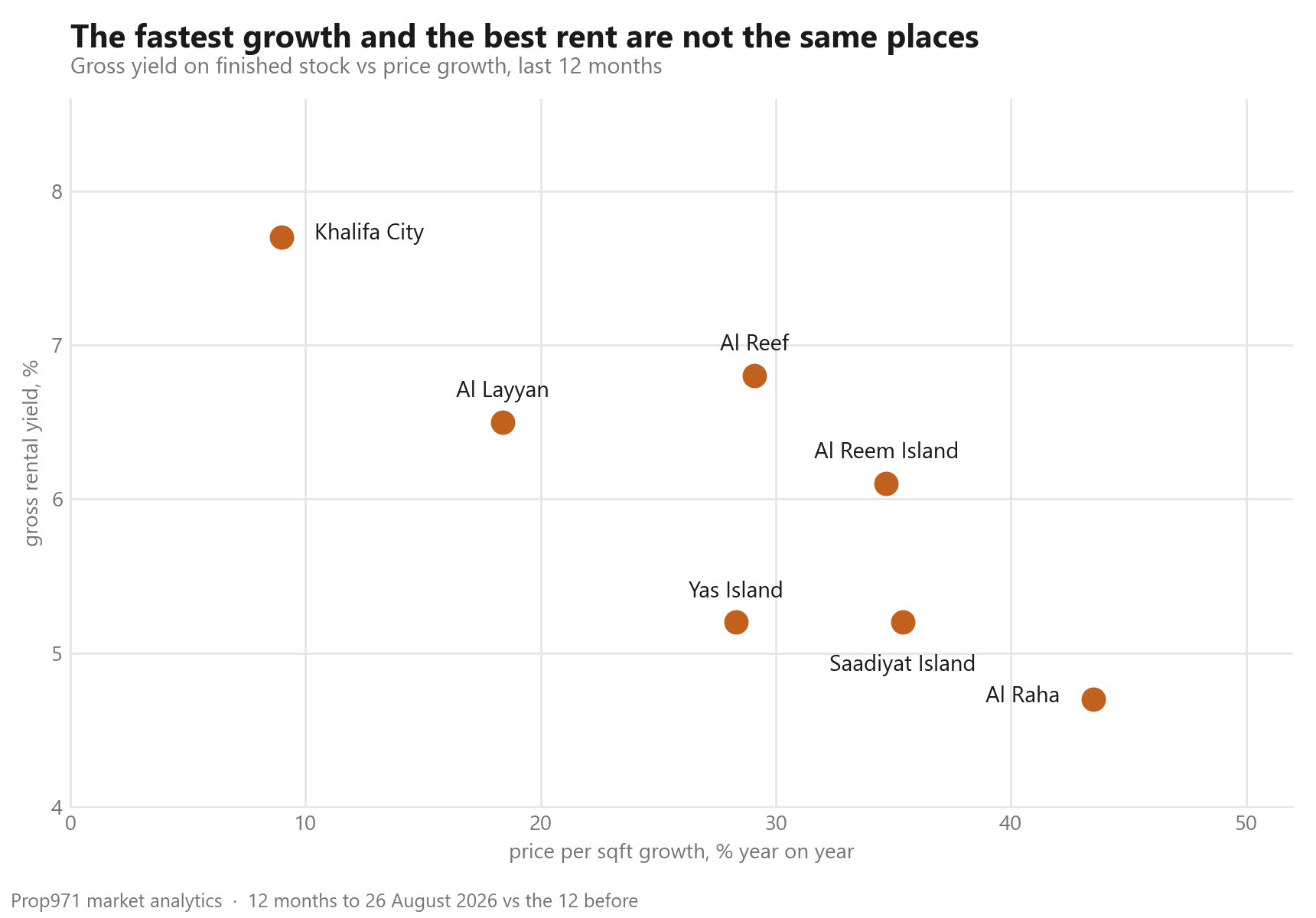
Growth and income live in different districts in Abu Dhabi, exactly as they do in Dubai. Gross yields, computed as median rent over the median price of finished stock in the same district for the same bedroom count:
| District | Gross yield | Price growth YoY | Sales, 12m | Median price |
|---|---|---|---|---|
| Khalifa City | 7.7% | +9% | 1,205 | AED 1.19M |
| Al Reef | 6.8% | +29% | 401 | AED 1.40M |
| Al Layyan | 6.5% | +18% | 257 | AED 800k |
| Al Reem Island | 6.1% | +35% | 8,449 | AED 1.75M |
| Saadiyat Island | 5.2% | +35% | 2,231 | AED 4.83M |
| Yas Island | 5.2% | +28% | 4,933 | AED 1.98M |
| Al Raha | 4.7% | +44% | 970 | AED 2.67M |
Khalifa City pays the most rent per dirham, 7.7% gross, on 9% growth. Al Reef pays 6.8% and Al Layyan 6.5%, both mainland, both at under AED 1,000 per square foot. At the other end, Al Raha yields 4.7% while leading the growth table, and Saadiyat and Yas Island both pay 5.2%.
The pattern is the same one that holds across the UAE: the tenant does not pay for the address, the buyer does.
Four districts where a yield cannot be computed at all
Hudayriyat Island, Fahid Island, Al Bahia and Zayed City have effectively no finished stock that has traded. Between 96% and 100% of their sales are off-plan. There is no completed-resale price to divide a rent by, because almost nothing has been handed over and re-sold.
That does not make them bad. Hudayriyat grew 25% and Fahid is one of the emirate's most expensive addresses at AED 3,661 per square foot. It makes them unmeasurable on income, which is a different thing, and the honest position is to say so rather than publish a yield built from a handful of leases.
If you are buying in any of those four, you are underwriting a rent that does not exist yet. That is a legitimate bet and it is the one every early buyer in a new district makes. Just be clear that it is a forecast rather than a number.
Al Reem Island is the one that does everything
Al Reem Island appears near the top of all three rankings at once, which nothing else in the emirate manages.
It cleared 8,449 sales, close to 30% of every transaction in Abu Dhabi. It grew 35%. It yields 6.1% gross, the best of any of the big island districts. And at AED 1,606 per square foot against Saadiyat's 3,174, it does all of that at roughly half the price of the address next door.
The caveat stands: its volume rose 129%, so part of that 35% is mix. But the yield is computed on finished stock only, from more finished sales than any other district here, and the sale count is real demand whichever way you cut it. Both hold up independently of the growth figure.
What Abu Dhabi charges that Dubai does not
Two structural differences change the arithmetic before any district does anything.
The transfer fee is 2%, registered with ADREC, against Dubai's 4%. On a AED 2m purchase that is AED 40k that stays in your pocket, which is most of a year's rent on a mid-market flat.
Freehold ownership for foreign buyers is limited to designated investment zones. Al Reem, Yas, Saadiyat, Al Maryah and Al Raha are inside them; much of the mainland is not. This matters directly to two districts in the yield table above, so confirm the ownership type for the specific plot before anything else, through ADREC or the UAE government portal. It is the one check where being wrong is not recoverable by negotiation.
The shortlist
Matching the three rankings to what a buyer actually wants:
- Income first: Khalifa City at 7.7% gross, then Al Reef at 6.8% and Al Layyan at 6.5%. All mainland, all under AED 1,250 per square foot, none of them on a postcard.
- Growth with the cleanest evidence: Saadiyat Island, the only district in the top three whose price rose while its volume fell.
- Balance: Al Reem Island, the sole district combining top-three growth, a 6%-plus yield and by far the deepest liquidity.
- Highest risk, highest unknown: Hudayriyat and Fahid, where you are buying the forecast rather than the record.
None of that is a prediction. Last year's +21% is a fact about last year, and the only way to hold any of it together is to re-run the three numbers on the district you shortlist at the moment you buy.
Doing that by hand means pulling medians, volumes and rents for two matched windows per district, which is dull work, and dull work is what people skip. Our market analytics hold the same records these tables came from, so re-checking takes minutes. The Dubai half sits in our best areas to invest in Dubai piece.
FAQ
What is the best area to invest in Abu Dhabi right now?
It depends which of the three metrics you optimise for: Khalifa City leads gross yield at 7.7%, Saadiyat Island leads clean price growth at +35% on falling volume, and Al Reem Island leads liquidity with 8,449 sales in twelve months. Al Reem is the strongest single balance of all three.
Which area in Abu Dhabi has the highest rental yield?
Khalifa City, at about 7.7% gross on finished stock, followed by Al Reef at 6.8% and Al Layyan at 6.5%. All three are mainland districts trading under AED 1,250 per square foot; the island addresses pay 4.7% to 6.1%.
Is Abu Dhabi better than Dubai for property investment?
On last year's numbers Abu Dhabi grew far faster, 20.6% against Dubai's 6.1% per square foot, and its transfer fee is 2% against Dubai's 4%. Dubai still offers much deeper liquidity, with roughly 330k transactions over two years against Abu Dhabi's 46k. Growth favoured Abu Dhabi; ease of exit still favours Dubai.
Can foreigners buy freehold property in Abu Dhabi?
Yes, but only within designated investment zones, which include Al Reem, Yas, Saadiyat, Al Maryah and Al Raha. Outside those zones foreign ownership is restricted, so confirm the ownership type for the specific plot before committing.
Why can some Abu Dhabi districts not be given a rental yield?
Because between 96% and 100% of sales in Hudayriyat, Fahid Island, Al Bahia and Zayed City are off-plan, so almost no completed property has traded. A yield needs a finished sale price to divide the rent by, and in those districts there is not yet a reliable one.
How much of Abu Dhabi's price growth is new launches rather than real appreciation?
Some of it, and the volume test separates them. Off-plan was 80% of sales at a 37% premium per square foot, so districts whose sales surged alongside their prices, such as Al Raha and Al Reem, carry a mix-shift caveat. Saadiyat, where prices rose while volume fell 22%, does not.
References
Figures in this article are computed from official UAE property transaction records (ADREC) via Prop971 market analytics, including transactions up to 26 August 2026.


