
Three out of four homes sold in Dubai last year did not exist yet. Off-plan purchases made up 76% of roughly 159k sales in the twelve months to late August, and every one of them was a payment against a promise: a floor plan, a render, and a handover date.
Promises vary. What does not vary is that Dubai measures them. Every registered project carries an official status, an inspected completion percentage, and a named escrow account, all of it public. A property status inquiry is the five-minute habit of reading those three fields before you pay, and this guide covers where to find them and, more usefully, what counts as normal when you do.
What a property status inquiry tells you
A property status inquiry returns the regulator's record of a project rather than the marketing version of it. Four fields do the work:
Project status. Active, finished, or not started. The register also records cancelled projects, which is precisely the kind of thing a brochure will not mention.
Completion percentage. How much of the project is actually built, recorded through inspections rather than reported by the seller. This is the single most useful number in the file.
Escrow account. The bank account, required by law for off-plan sales, where buyer money must sit until construction milestones release it. The register names the account and the bank.
Registration. Whether the project is registered with the Real Estate Regulatory Agency (RERA), the Dubai Land Department arm that oversees developers and projects.
The pattern worth noticing: the first two fields test the timeline you were quoted, and the second two test what happens to your money if the timeline moves. You want all four.
How to check a project's status with the Dubai Land Department
The check is free and public. On the Dubai Land Department's project status service, search the project by name and the record returns its status, completion percentage, developer registration and escrow details. The same lookup exists in the Dubai REST app. For the rules that govern who can buy and where, the UAE government portal carries the ownership framework.
Two practical notes. First, projects are registered under their formal names, which do not always match the marketing name on the hoarding, so search a shorter fragment if the full name returns nothing. Second, the completion percentage updates when an inspection happens, not continuously; a figure a few months old is a stale reading, not a stalled site. The date attached to the record tells you which it is.
That is one project, checked in five minutes. The friction arrives when you are comparing six, because the register is built for looking up a name you already know, not for browsing. Our projects catalogue carries the register's status, completion percentage and escrow fields on each project page, next to the prices and payment plan, so the comparison happens on one screen instead of six lookups.
What completion percentages look like across the market
Numbers only mean something against a baseline, so here is the baseline. Of the 1,197 Dubai projects tracked on Prop971 and matched to the official register, 790 are active, 385 are finished and 22 have not broken ground. Across the active ones, the median recorded completion is about 20%.
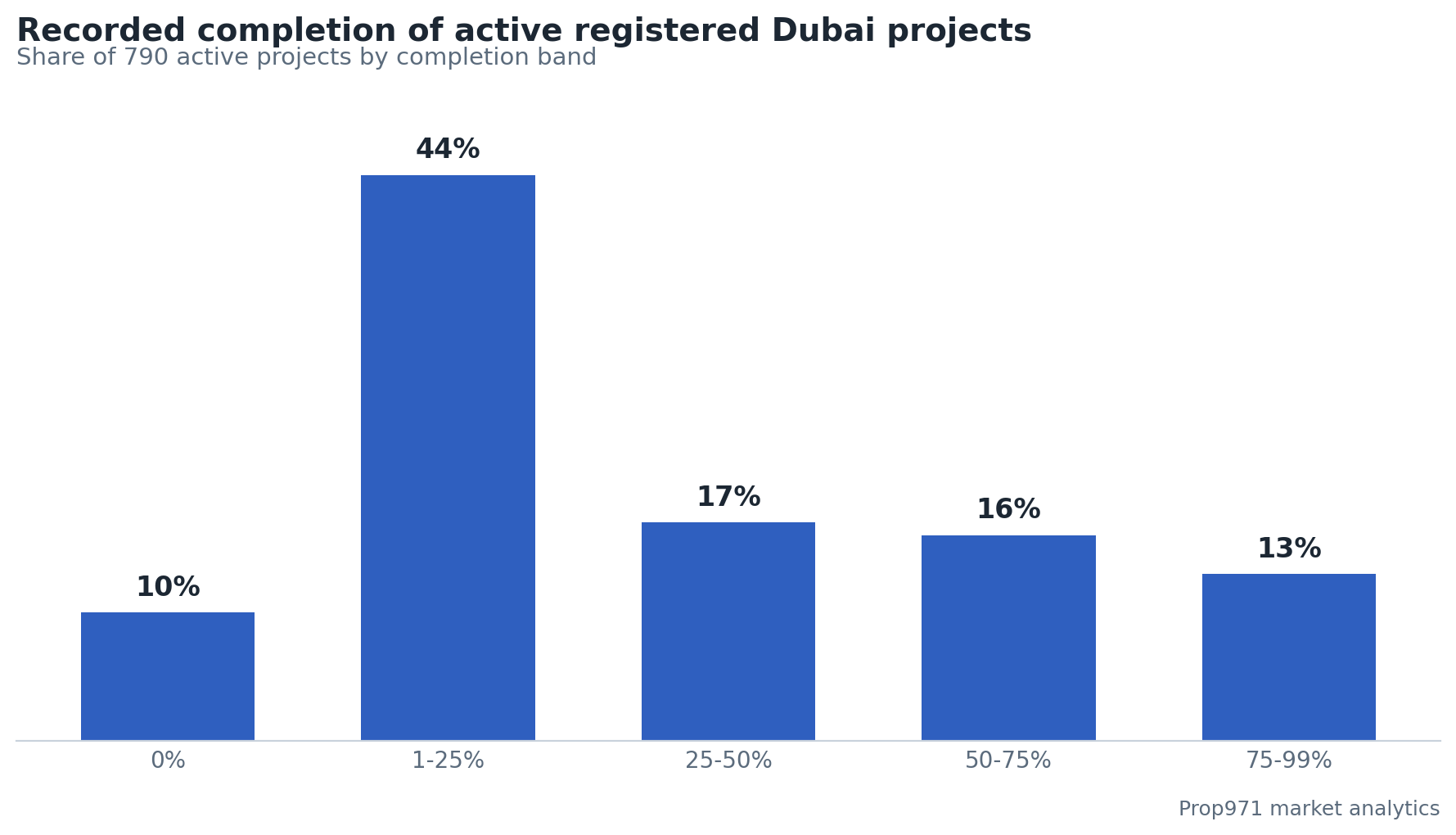
Read the left side of that chart correctly: 54% of active projects are below 25% complete, and 78 of them stand at exactly zero. Zero is not a scandal. Off-plan sales legally open before ground breaks, which is why the newest launches routinely sell at 0%, and it is also why the escrow rule exists.
That rule is the part to take seriously. 97% of the matched projects have a named escrow account on record. Your payments belong in that account and nowhere else, because money in escrow is released to the developer against verified construction progress, and money paid outside it carries no such protection. Before any transfer, match the account you are given against the account the register names. If a seller offers a discount for paying outside escrow, the discount is the price of removing the protection.
The handover test: advertised dates against recorded progress
A handover date is a plan. A completion percentage is a measurement. Comparing the two is the sharpest test a buyer can run, and across the market the comparison looks like this:
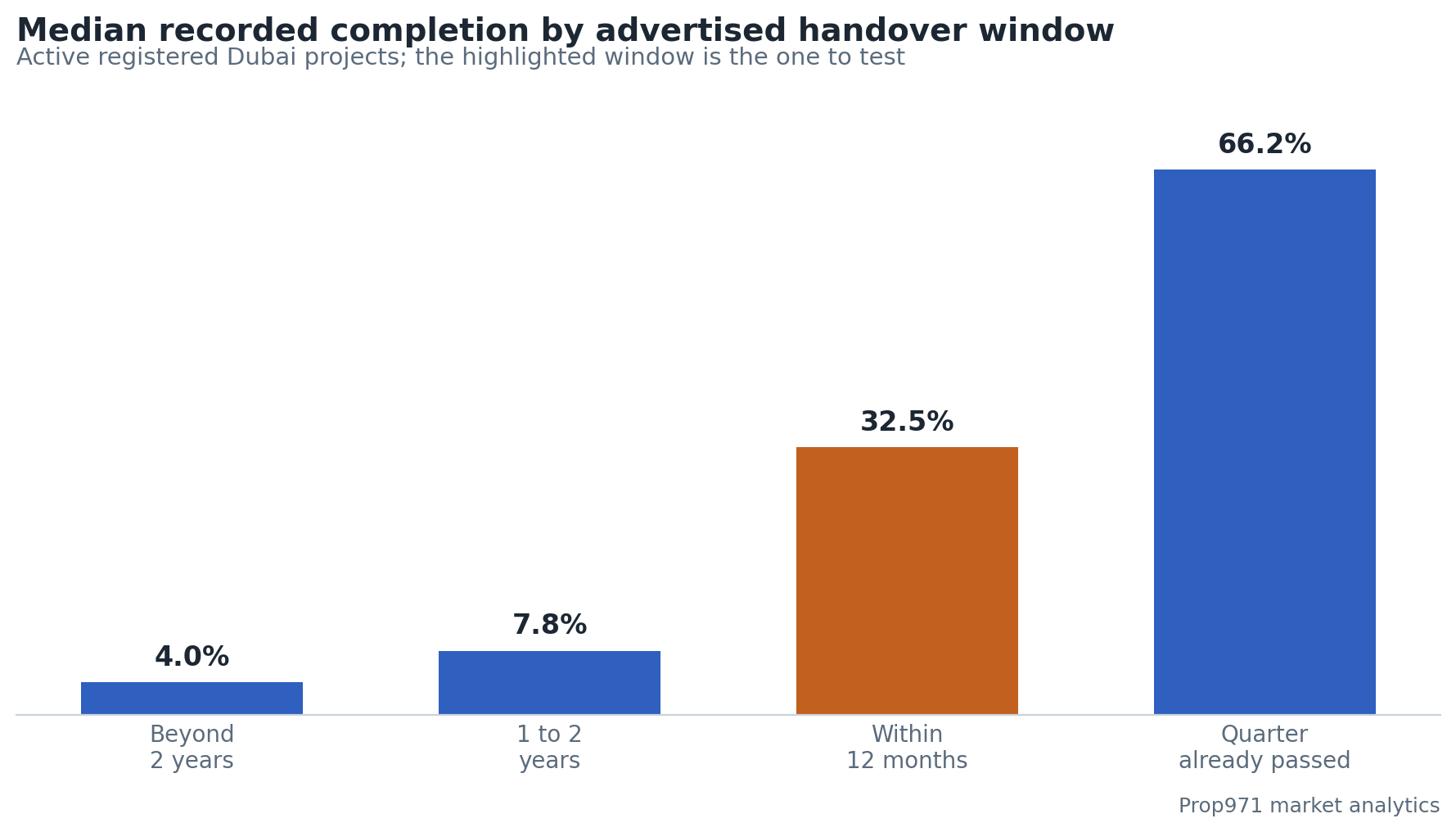
The staircase is the market working roughly as designed: the further out the promise, the less is built. The step that deserves your attention is the third one. Among 235 active projects advertising handover within the next twelve months, the median recorded completion is 32.5%, and about 65% of them sit below half built. Some of those will close the gap, construction is not linear and the final fit-out phases move fast. But a tower promising keys in nine months from a 30% base is asking you to believe in an unusually productive year.
There is also a fourth step the chart makes visible: 161 active projects whose advertised quarter has already passed, at a median of 66% complete. Timelines in this market get revised, often more than once, and the register is simply where a revision becomes visible before the announcement does.
So the test, concretely: if handover is advertised within twelve months and recorded completion is under 50%, ask the developer two questions. Which inspection date does the figure reflect, and what is the current expected completion quarter. A recent inspection plus a confident answer is an acceptable outcome. A stale figure plus a vague answer tells you to price in a later date, which changes what a payment plan is actually worth to you.
Off-plan pricing already assumes patience. Dubai off-plan sold at about AED 1,800 per square foot over the last year against roughly AED 1,406 for ready property, a premium near 28%, which you can weigh district by district on our price analytics. The premium buys tomorrow's building at tomorrow's price. The status inquiry is how you check how much of tomorrow has been built.
Five checks before you sign
| The check | Where | What good looks like |
|---|---|---|
| 1. Project status | DLD project status service / Dubai REST app | Active or finished. Not started is fine for a new launch; cancelled ends the conversation. |
| 2. Completion vs handover | Same record, next to the advertised date | Handover within 12 months should sit on 50%+ recorded completion. Below that, ask for the inspection date and the current expected quarter. |
| 3. Escrow account | Named in the project record | The account you are asked to pay into matches the account the register names. Every payment goes into it, none around it. |
| 4. Oqood registration (off-plan) | DLD, after signing | Your purchase is registered in your name against the project. Ask the developer for the Oqood certificate; the fee is typically 4% of the price. |
| 5. Title deed (ready property) | DLD verification service | The seller’s deed is genuine and the property is free of blocking encumbrances before transfer. |
The first two catch timeline risk while it is still negotiable. The escrow check protects the money itself. The last two close the paper trail: Oqood is the interim registration that records an off-plan buyer's ownership with the DLD before a title deed exists, and the title deed check does the equivalent for a finished home.
None of this takes an afternoon. It is five lookups against public records, and it converts the least reliable sentence in real estate, "handover is on track", into numbers you can read yourself.
FAQ
What is a property status inquiry?
A property status inquiry is a lookup of a project's official record: its status (active, finished, not started or cancelled), its inspected completion percentage, its RERA registration and its escrow account. In Dubai the record is public and free through the Dubai Land Department's online project status service and the Dubai REST app.
How do I check a project's status with the Dubai Land Department?
Search the project's name on the DLD project status service or in the Dubai REST app, and the record returns status, completion percentage and escrow details. Projects are filed under formal names that can differ from marketing names, so try a shorter fragment if the full name returns nothing.
What is RERA project status?
RERA project status is the Real Estate Regulatory Agency's record of whether a project is registered and in what state: active, finished, not started or cancelled. RERA is the Dubai Land Department arm that regulates developers, and an unregistered project is one to walk away from.
What does the completion percentage mean?
The completion percentage is the share of construction the regulator has recorded as built, based on inspections rather than developer statements. It updates when an inspection happens, so check the date attached to the figure; a reading a few months old may simply be awaiting the next inspection.
Is 0% completion a red flag?
Not by itself. Off-plan sales legally open before construction starts, and 78 of the 790 active registered Dubai projects we track stand at exactly zero. The protection at that stage is the escrow account: your payments sit in a regulated bank account and release against verified progress, so confirm the account before paying anything.
What is an escrow account in Dubai?
An escrow account is a bank account, mandatory for off-plan projects, that holds buyer payments and releases them to the developer only against verified construction milestones. The account and bank are named in the project's official record, and payments belong in that account and nowhere else.
References
Figures in this article are computed from official UAE property transaction records (DLD) via Prop971 market analytics, including transactions up to 31 August 2026.


