
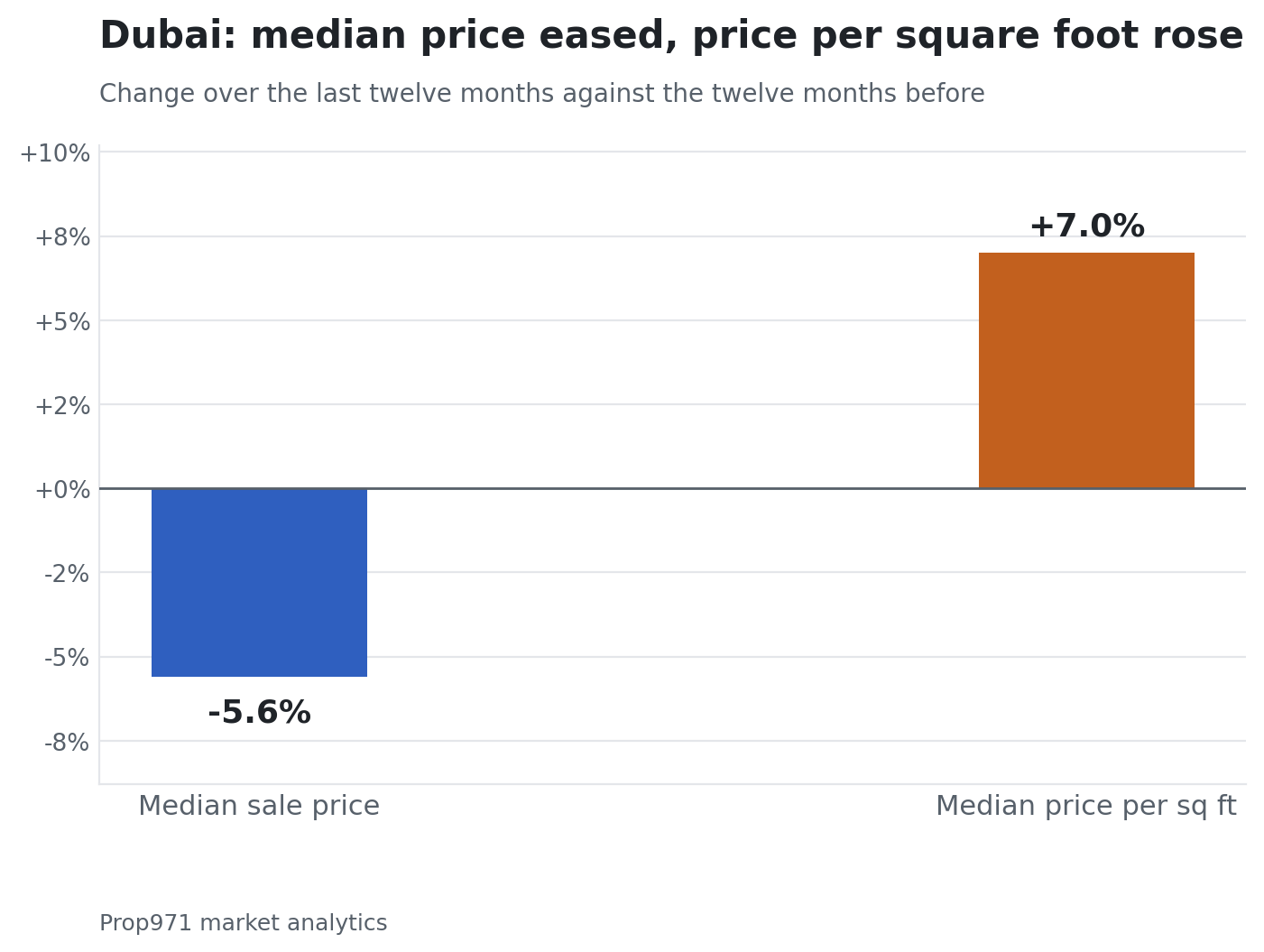
The median home in Dubai sold for about AED 1.31 million over the last twelve months, roughly 5.6% below the year before. That sounds like the start of a bargain hunt. It is not, and the reason is the single most useful thing anyone considering investment in property in Dubai can learn this year.
Over the same twelve months, the median price per square foot rose 7.0%, from about AED 1,623 to AED 1,737.
Both numbers are correct. The home got cheaper. The square foot did not.
The headline price fell. The price of space went up.
When a median price drops while the median price per square foot climbs, the market has not repriced. The mix has changed. Buyers bought smaller.
That is worth stating flatly, because "prices are down" is doing a lot of work in a lot of sales conversations right now. Down!
The test is simple enough to run on any district or building you are shown. Ask for two numbers rather than one: the median price, and the median price per square foot. If the first has fallen and the second has risen, nothing is on sale. You are looking at a market that sold more studios and one-bedrooms this year than last, which is a fact about demand, not about value.
Dubai recorded about 163,000 sales in the twelve months to August 2026, against roughly 168,000 the year before. Volume is essentially flat at a very high level, which is the more honest description of a market that spent the prior year setting records.
Can foreigners buy property in Dubai?
Yes, in designated freehold areas, with full ownership of the unit and no requirement to live in the UAE. This is the part that surprises people who have not looked recently: there is no nationality restriction and no local partner requirement in freehold zones.
What matters for an investor is not whether you can buy but what you receive. Freehold gives you the title in your own name. Leasehold, still common in parts of the city, gives you rights for a fixed term. The distinction is recorded on the title deed, and it is the first document to read rather than the last.
Buying off plan in Dubai costs more per square foot, not less
Here is the finding that most surprises first-time buyers. Over the last twelve months in Dubai, off-plan units sold at a median of about AED 1,808 per square foot against about AED 1,404 for finished property. That is a premium of roughly 29% for the version that has not been built yet.
Off-plan is also where the market is. About 76% of Dubai sales in the last twelve months were off-plan, up from 71% the year before.
None of that makes buying off plan in Dubai a mistake. It buys time: a payment plan spread across construction, a lower cash outlay at entry, and whatever the market does between now and handover. Handover is the date the developer gives you the keys, and everything you are paying for sits on the other side of it. But the premium is the price of that option, and it should be named as one rather than described as a discount.
The comparison that matters is not off-plan against off-plan. It is off-plan against the finished unit down the road, which you can inspect, let immediately, and buy for about a fifth less per foot. We put the two side by side in off-plan versus ready property.
What you pay on top of the price
The purchase price is not the cost. The DLD fee, the transfer fee charged by Dubai Land Department, is 4% of the purchase price, and on a median-priced home that is roughly AED 53,000 before anything else. Registration and trustee charges sit on top, and off-plan purchases are registered through Oqood, the pre-handover registration system, rather than a full title deed until completion.
Two things protect the money in between. Off-plan payments go into an escrow account tied to the project rather than to the developer's balance sheet. And the construction completion percentage is published, so the honest question to ask about any off-plan unit is not when it will be finished but what percentage is complete today.
Can you get an off-plan mortgage in Dubai?
Partly, and later than most buyers expect. Banks in the UAE do lend against off-plan property, but typically at a lower loan-to-value than for finished homes, and often only once construction passes a threshold. In practice the developer payment plan does the financing during construction and a mortgage takes over at or near handover.
That sequencing matters more than the rate. A payment plan is an obligation on a schedule you agreed at launch, and it does not care what a bank thinks of your income three years later. Model the handover payment before signing the first one.
The yield runs backwards to the size of the unit
If the goal is income rather than appreciation, the most useful chart in this article is the next one, and it points the opposite way to most people's instincts.
On finished Dubai stock over the last twelve months, gross yields ran at about 7.0% for studios, 5.3% for one-bedrooms, 3.8% for two-bedrooms and 3.7% for three-bedrooms. Gross means before service charges, vacancy and management, so treat it as the ceiling rather than the take-home.
The smallest unit in the market earns the most against its price. That is the single most reliable pattern in the data, it holds in both emirates, and it is almost never how a larger unit gets sold to an investor.
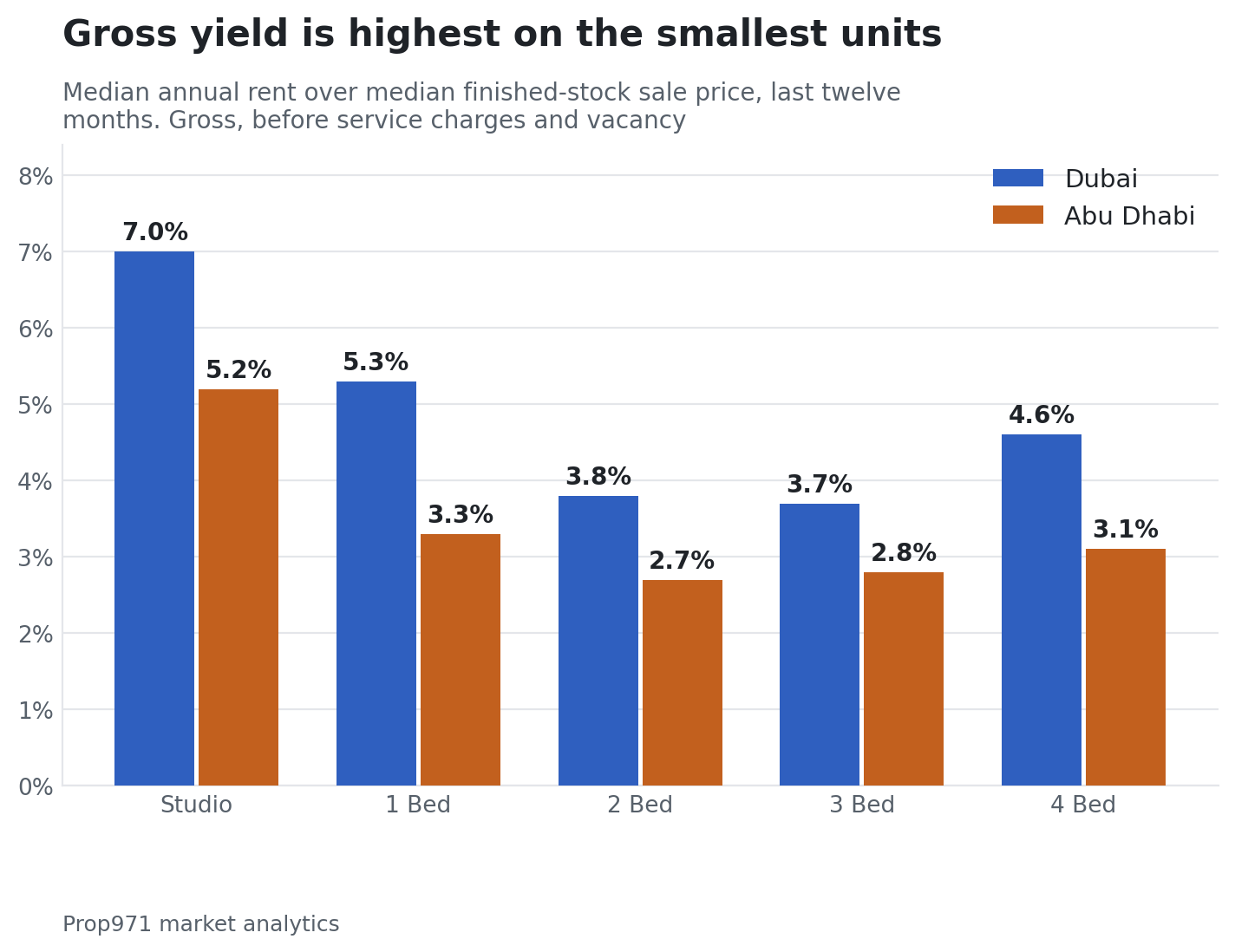
For anyone screening for the best property investment Dubai offers on income alone, that curve is the starting point. It is not the whole answer, because a studio in a weak location still competes with every other studio in it, but a three-bedroom starts about 3.3 points behind a studio on gross yield. The curve is not perfectly smooth either: four-bedroom stock ticks back up to about 4.6%, which is villa pricing rather than a break in the pattern.
Abu Dhabi off plan is growing from a smaller base
Dubai is not the whole market, and the other emirate is having a different year. Abu Dhabi recorded about 28,000 sales in the twelve months to August 2026, up 68% on the year before, with the median price per square foot up 21% to about AED 1,721.
Abu Dhabi off plan now accounts for about 80% of sales there, up from 64%. The off-plan premium is wider too, at roughly 37% per square foot over finished stock against Dubai's 29%.
The trade is visible in the yield table. Abu Dhabi studios yielded about 5.2% gross against Dubai's 7.0%, and its two-bedrooms about 2.7% against 3.8%. Faster growth, thinner income. Which of those two you want is the actual investment decision, and it is worth making deliberately rather than by postcode.
Does buying property get you a golden visa?
Yes, above a published threshold. A property golden visa is available on property worth AED 2 million or more, granting long-term residency renewable without an employer sponsor. It can be met with off-plan property from an approved developer and with mortgaged property, subject to the conditions in force at the time of application.
Two practical notes. The threshold is measured on the property's registered value, not the advertised price, and the visa follows the asset, so selling below the threshold ends the basis for it. Check the current terms with the Federal Authority for Identity and Citizenship rather than with anyone selling you the unit.
Where to start
Three numbers, in this order. The price per square foot for the district, so you can tell a discount from a smaller floor plan. The gross yield for that bedroom count, so you know what the income ceiling looks like. And the completion percentage if it is off-plan, so you know what you are actually buying.
Current listings sit on projects and new launches, and the district-level price and yield figures behind this article are on the market dashboard.
FAQ
Is property in Dubai a good investment in 2026?
The data supports it on income and stability rather than on a discount. Gross yields on finished Dubai stock ran at about 7.0% for studios and 5.3% for one-bedrooms over the last twelve months, price per square foot rose 7.0%, and volume held near record levels at about 163,000 sales.
Why did Dubai's median price fall while prices per square foot rose?
Because buyers bought smaller units, not cheaper ones. The median price eased 5.6% over the last twelve months while the median price per square foot rose 7.0%, which is a change in the mix of what sold rather than a repricing of space.
Can foreigners buy property in Dubai?
Yes. Foreign nationals can buy with full ownership in designated freehold areas, with no residency requirement and no local partner. The ownership type is recorded on the title deed.
Is buying off plan cheaper than buying a finished home?
No, not per square foot. Off-plan sold at a median of about AED 1,808 per square foot in Dubai over the last twelve months against about AED 1,404 for finished property, a premium of roughly 29%. What off-plan buys is a payment plan and time, not a lower price per foot.
What is the DLD fee when buying property in Dubai?
The Dubai Land Department transfer fee is 4% of the purchase price, with registration and trustee charges on top. On a median-priced Dubai home that works out at roughly AED 53,000.
How much property do you need for a golden visa?
AED 2 million of property, measured on the registered value. It can be met with off-plan or mortgaged property subject to the conditions in force, and long-term residency is renewable without an employer sponsor.
References
Figures in this article are computed from official UAE property transaction records (DLD, ADREC) via Prop971 market analytics, including transactions up to 12 August 2026.


